
The Warsaw Ghetto Uprising
Spy author Alex Gerlis writes about the armed act of Jewish resistance that partly inspired his novel, Agent in Peril.

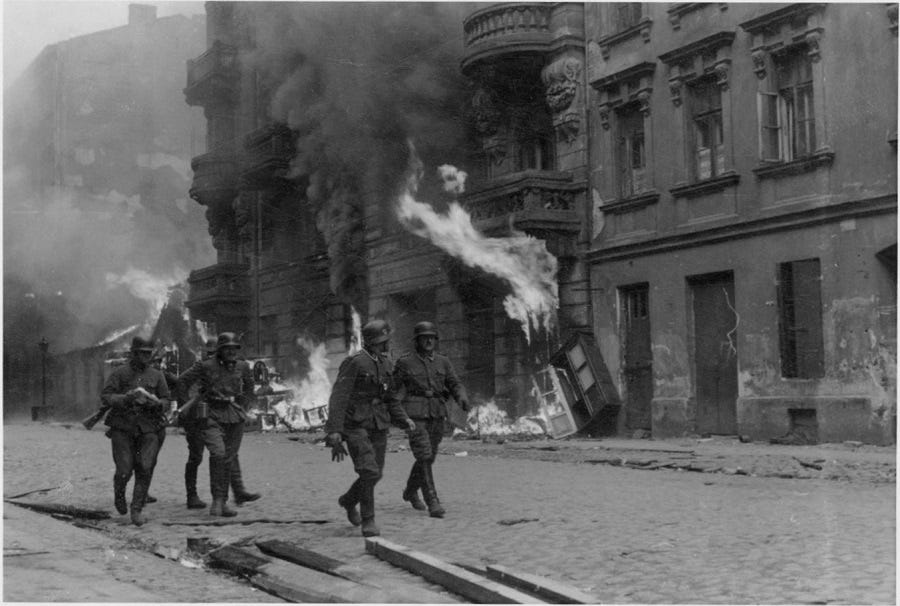
In all my novels, there are a number of plot lines which converge at the end of the book, but in my new book, Agent in Peril the core plot is based around the Battle of the Ruhr in 1943, the RAF’s bombing campaign from March-July that year targeting Germany’s industrial heartland. Agent in Peril actually opens a long way from the Ruhr: much of the early part of the book is set in Poland, though by 1943 Poland had ceased to exist as a separate entity of that name – part of the Nazi policy of undermining the identity of the Occupied countries. As a consequence Poland came under the General Government.
By the time I came to planning this, my tenth novel, I felt that writing about Poland was long overdue. The bare facts of the Nazi occupation of Poland and the scale of suffering are astonishing and difficult to grasp, even within the horrendous context of the Second World War. From the country’s invasion in September 1939 to its liberation by the Red Army in early 1945 the country suffered unimaginable losses. The estimates of how many Polish citizens died vary, but the consensus seems to be three million. In addition, three million of Poland’s pre-war population of 3.3million Jews were murdered during the Holocaust: most in the six death camps the Nazis established on Polish soil, others in the ghettos or at the hands of the Einsatzgruppen, the so-called death squads.
