The U-Boat War
A new history of U-Boat warfare tells us German subs away from the traditional view. By Lawrence Paterson.

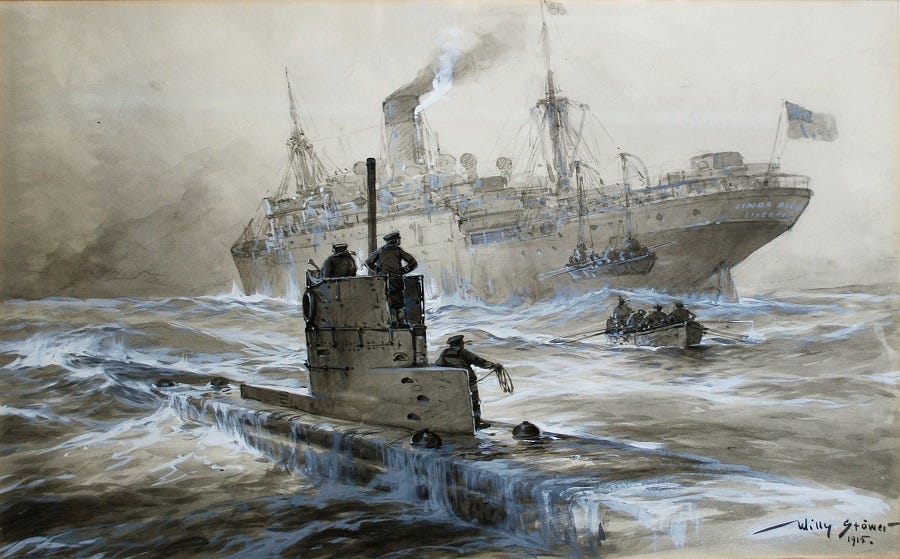
A strong mythology surrounds Karl Dönitz’s U-boat War War; not least of all the idea that roving U-boat ‘Wolfpacks’ routinely savaged North Atlantic convoys and posed a dramatic threat to Great Britain’s continued survival after the disastrous battle for France in 1940. Dönitz’s pre-war tactical doctrine had focussed on the ‘Rudeltaktik’ (‘Group Tactics’ anglicised as the ‘Wolfpack’), an idea originating with the commander of the First World War’s U-boats, Fregattenkapitän Hermann Bauer. Bauer had achieved great success in 1917 with Germany’s unrestricted U-boat offensive, bringing Britain’s merchant shipping balance to near bankruptcy. However, this was achieved by U-boats operating independent of each other or any centralised control and as such they were defeated by the British Admiralty introducing convoying of merchants as a means of ‘collective defence’.
Sensing that the impetus was slipping from his grasp, Bauer proposed to German Naval Staff that U-boats alter tactics and instead be coordinated and controlled by means of a large radio-equipped transport U-boat that could operate as a mobile command centre. Staffed by trained wireless and decryption personnel, this U-boat would monitor British radio signals to anticipate convoy movements and direct accompanying combat boats to intercept en-masse; the theoretical birth of the ‘Wolfpack’. However, despite Bauer’s sound logic, the proposal was rejected.
Subsequent defeat of Germany’s U-boats was mistaken in Britain as decisive Allied victory, though just under half of operational U-boats built remained combat-effective by the time of the November 1918 Armistice. It had not only been improved anti-submarine warfare techniques and the introduction of escorted convoys that had beaten the U-boats but also their failure to forge fresh tactical doctrine, particularly after Bauer’s replacement in June 1917.
By September 1939 as Europe plunged once again into war Dönitz had drilled his commanders and crews extensively in improved combat methods. Gone were long-distance submerged torpedo attacks, the men instead trained to launch torpedoes at close range while running surfaced at night, using the U-boat’s high diesel engine speed, manoeuvrability, and low profile to its fullest advantage. Radar was uncommon on enemy ships at that time — as well as its potential underestimated in Germany — and by operating surfaced, British ASDIC sonar location was rendered useless.